The story of the American neighborhood is usually told as a slow fade. Fewer block parties, fewer borrowed cups of sugar, more strangers separated by a property line.
Pew Research Center reported in 2025 that just 26% of Americans know all or most of their neighbors, down from 31% in 2018, and trust has slipped alongside it. Coverage of that decline has treated it as drift, the quiet loosening of ties nobody bothered to maintain.
The Good Neighbor Report, a new survey of 1,000 U.S. adults commissioned by Garon Fence, tells a different story. The retreat is deliberate. 46% of Americans admit they have physically hidden from a neighbor to avoid an interaction, waiting inside, killing the lights or slipping out a different door. Nearly half are carrying an unresolved tension with a neighbor right now.
And the stakes are financial. 39.7% of Americans would pay at least $5,000 above asking price to guarantee good neighbors, while 41.0% say bad ones would make them walk away from a house entirely. The people next door have become a line item.
One more surprise: for all the yard signs and flags, the war next door is not political. Ideological differences rank last among neighbor tensions at 3.6%, behind noise, pets and an unmowed lawn.
Key findings
- Nearly half of Americans (46%) have physically hidden from a neighbor, waiting inside until the coast is clear (31.1%), pretending not to see them (20.4%), killing the lights (8.5%) or leaving through a different door (7.2%)
- 39.7% would pay $5,000 or more above asking price for good neighbors, and 41.0% would walk away from a home purchase over bad ones
- 16.8% have moved because of a difficult neighbor; 39.2% have moved or considered it
- 47.8% are living with a current or recent unresolved neighbor tension, and politics ranks last among the causes at 3.6%
- 30.3% have had a dispute over property boundaries or shared spaces, with fence lines the single most common trigger at 9.5%
- 77.7% rate their own neighbor behavior as excellent or good, yet 57.0% can name something a neighbor does that bothers them
- 49.1% have installed or seriously considered a fence specifically because of neighbor behavior, and 24.7% actually built one
Nearly half of Americans have hidden from a neighbor
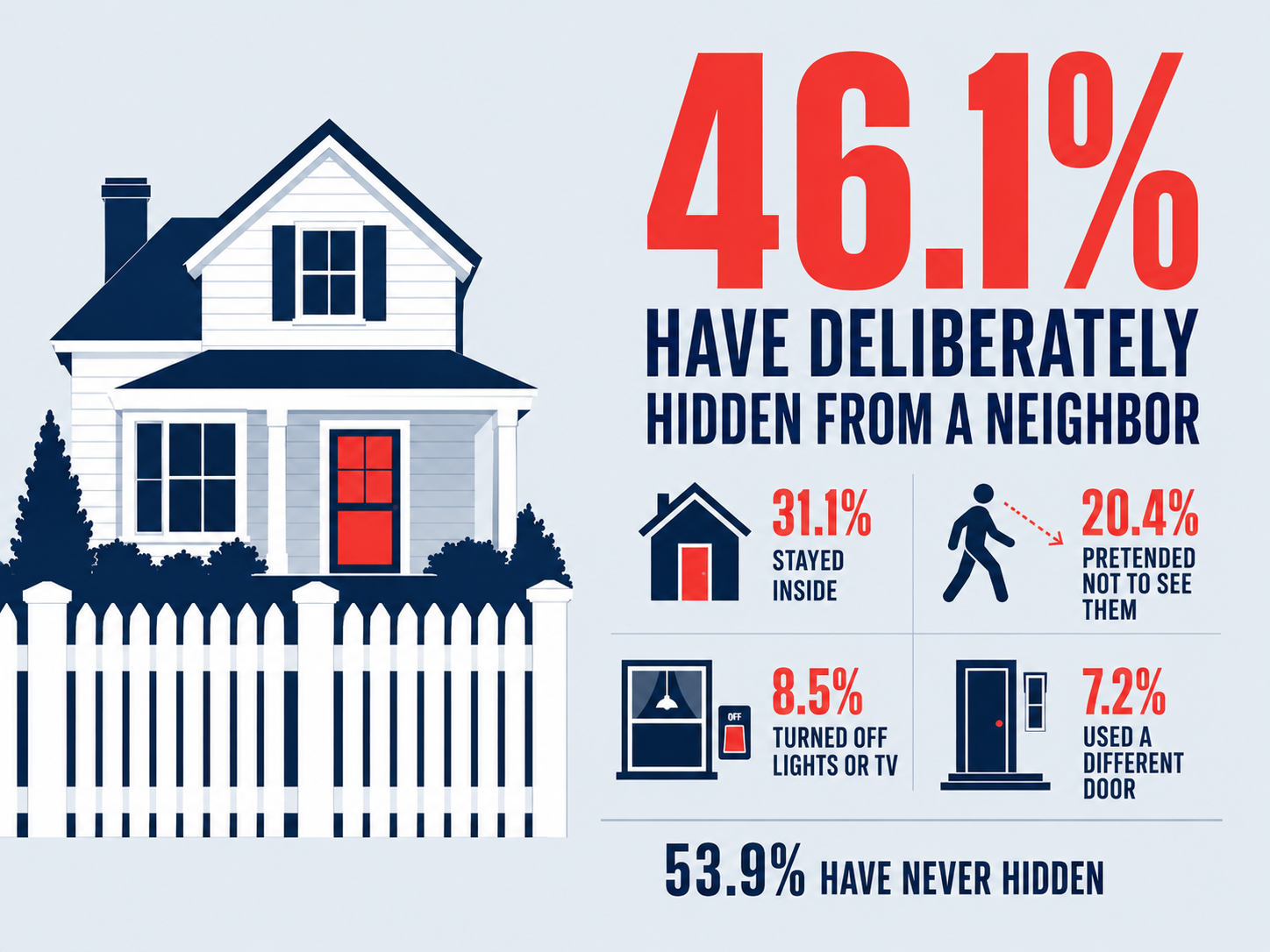
Avoiding a neighbor used to mean a polite wave and a quick exit. The survey finds something more committed. Only 53.9% of U.S. adults say they have never deliberately hidden from a neighbor.
Among the rest, 31.1% have stayed inside until the neighbor went back in, 20.4% have pretended not to see them and kept walking, 8.5% have turned off lights or the TV to fake an empty house and 7.2% have left through a different door.
The behavior concentrates where life is busiest. Among adults with children under 18 at home, only 45.7% have never hidden, compared with 64.6% of parents whose children are grown. Younger adults hide most of all: roughly 40% of Gen Z say they have never done it, versus about 65% of Baby Boomers.
Set against Pew’s finding that fewer Americans know their neighbors at all, the hiding data reframes the decline. Americans are not passively losing touch with the people next door. Nearly half the country is actively working to stay out of their sight.
Nearly half are living with unresolved neighbor tension right now
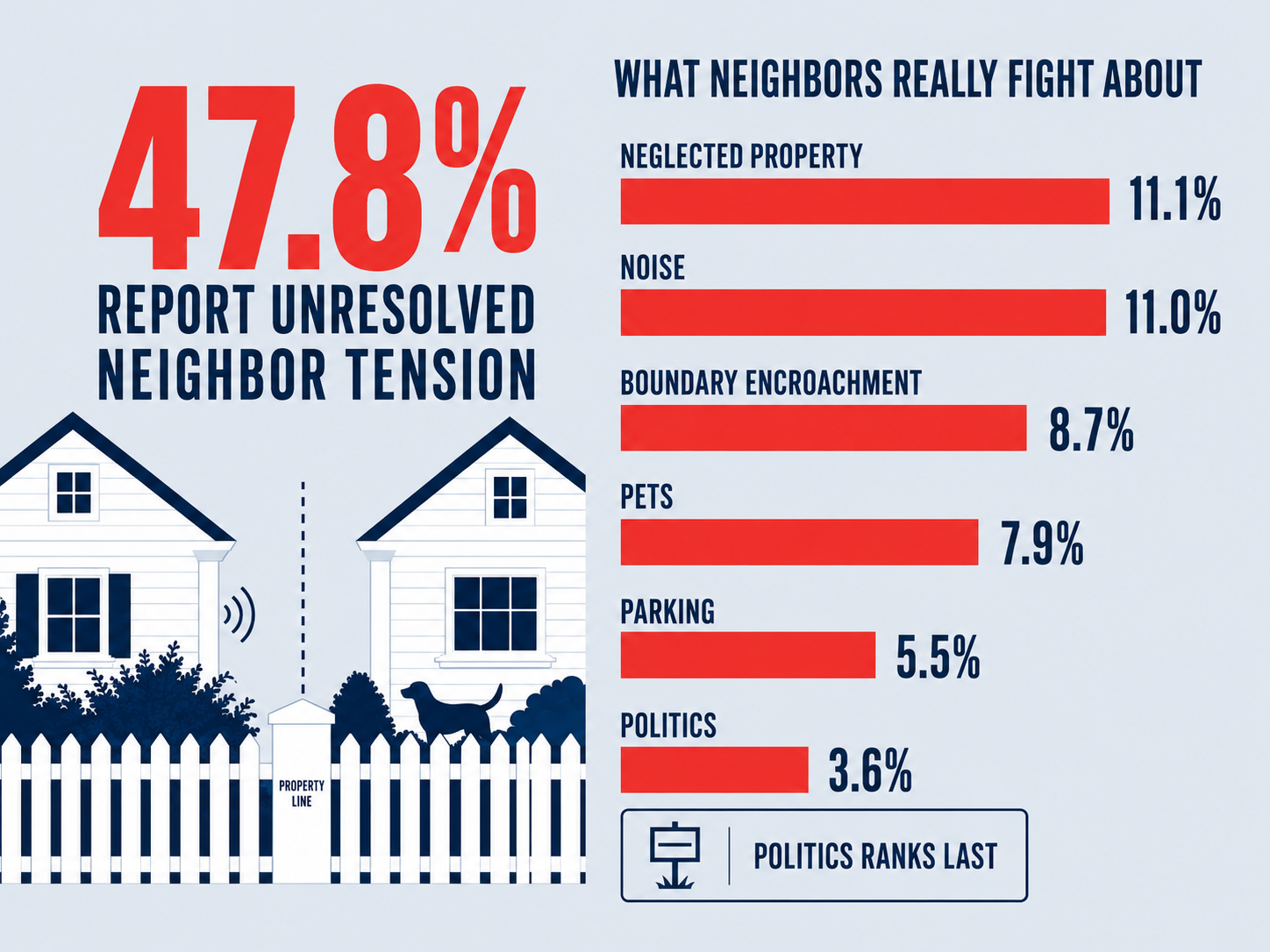 Distance has not bought peace. 47.8% of Americans report a current or recent unresolved tension with a neighbor. The leading sources are ordinary and physical: a neglected-looking property, noise, boundary encroachment on shared space, and pets.
The surprise is what sits at the bottom of the list. Political or ideological differences rank last among named tensions at just 3.6%.
For all the attention paid to yard signs and flags, the friction that actually festers between neighbors is about upkeep, decibels and square footage. In the American neighborhood, the yard sign gets a pass; the barking dog does not.
Ranked, the sources of unresolved neighbor tension look like this:
- A neglected-looking property: 11.1%
- Noise: 11.0%
- Boundary encroachment on shared space: 8.7%
- Pets: 7.9%
- Parking: 5.5%
- Politics: 3.6%
That gap between expectation and experience is a decade old. In 2016, Pew found roughly four in ten partisans on both sides expected it would be easier to get along with a neighbor who shared their party.
And political spats do happen: a 2024 Redfin-commissioned Ipsos survey found nearly one in five adults under 65 has argued with a neighbor over politics at some point.
But an argument that blows over is one thing. When Americans name the tension they are actually living with, politics barely registers. The election passes; the barking dog stays.
“We expected politics to be a bigger source of friction. What the data shows is that Americans will forgive a yard sign long before they forgive a barking dog or an unmowed lawn,” said Matt Prato, President at Garon Fence.
Tension is not evenly distributed. Men (54.8%) report it notably more often than women (42.8%), a pattern consistent with prior surveys, and the rate falls steadily with age, from 56% of Gen Z to 37% of Boomers.
Fence lines are the most common boundary dispute in America
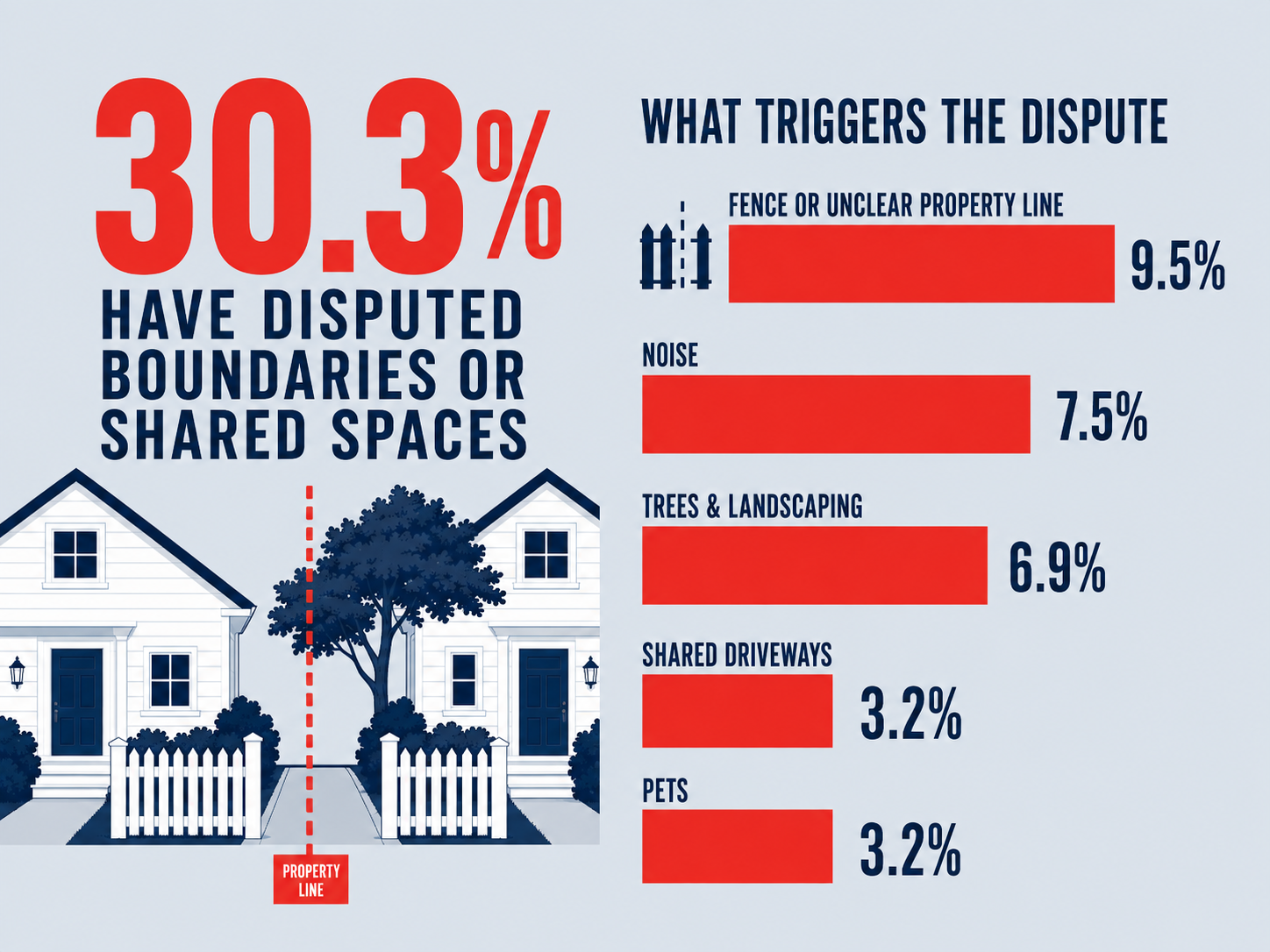 When tension breaks into open conflict, it usually happens at the property line. 30.3% of U.S. adults have had a dispute with a neighbor over boundaries or shared spaces, and the most common trigger is a fence line or unclear property line at 9.5%, ahead of noise (7.5%), trees and landscaping (6.9%), shared driveways (3.2%) and pets (3.2%).
Another 12.9% say a dispute came close and they bit their tongue, which puts 43.2% of Americans at or near the edge of open conflict with the people next door.
Here too the demographic structure is sharp. Parents with children under 18 report disputes at 37.8%, well above the 24.6% among adults with no children at home, and Gen Z reports them at nearly four times the Boomer rate, roughly 50% versus 13%.
Almost everyone thinks they are the good neighbor
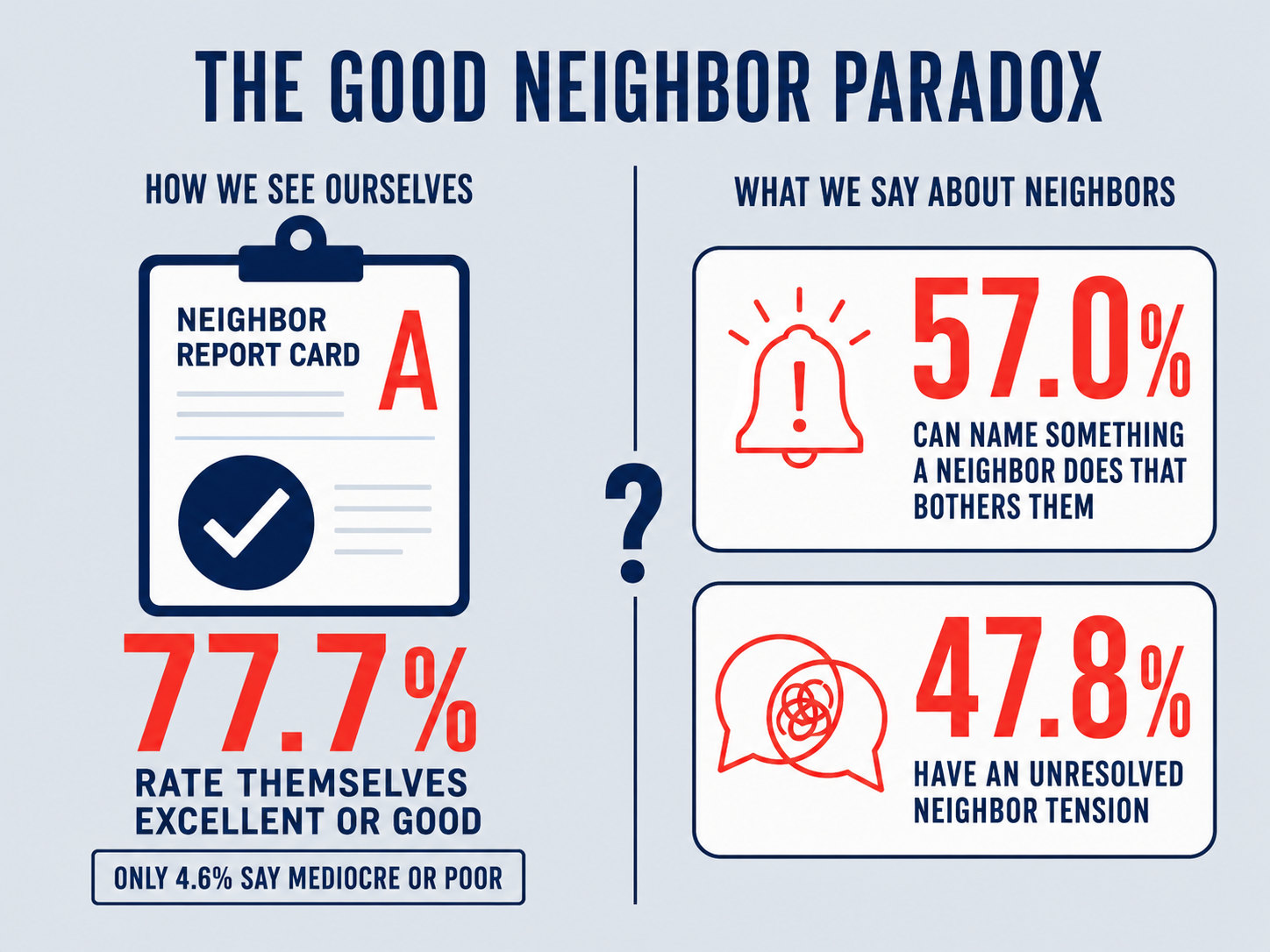 Ask Americans to grade themselves and the neighborhood, and it is a virtuous place. 77.7% rate their own behavior as a neighbor excellent or good. Only 4.6% will admit to being mediocre or poor.
The math does not survive contact with the rest of the survey. 57.0% of the same respondents can name at least one thing their neighbors do that bothers them, and 47.8% are carrying a live unresolved tension. If almost no one is the problem neighbor, someone is miscounting.
Self-regard holds flat across nearly every demographic line. Boomers (82%) and Gen Z (77%) rate themselves almost identically well. The one real break is income: only 63.4% of adults earning under $25,000 rate themselves excellent or good, and 11.0% rate themselves mediocre or poor, more than five times the 2.1% rate among households earning $50,000 to $99,999.
Good neighbors command a five-figure premium
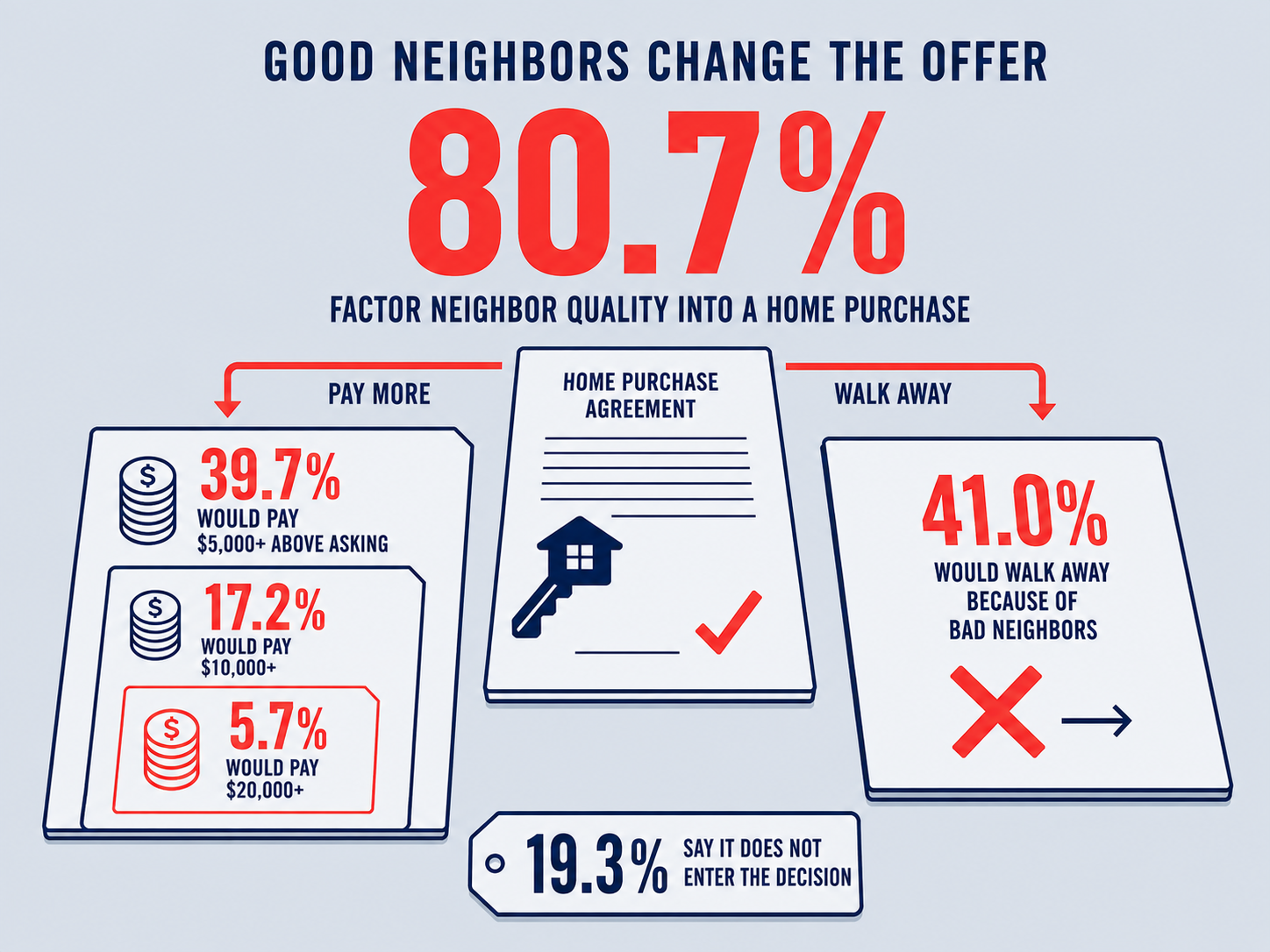 The clearest measure of what neighbors are worth arrives at closing. 39.7% of Americans would pay at least $5,000 above asking price to guarantee good neighbors. 17.2% would go to $10,000 or more, and 5.7% would pay $20,000 or more.
The premium is only half the picture. Another 41.0% of all Americans would not pay extra but say bad neighbors would make them walk away from a purchase entirely. Combined, 80.7% of Americans factor neighbor quality into a home purchase in some financial way. Only 19.3% say it does not enter the decision at all.
Professional appraisers have long priced what this survey measures. The Appraisal Institute has warned that bad neighbors, from unkempt yards to barking dogs, can cut nearby home values by more than 5 to 10 percent, a drag its members call external obsolescence.
Who pays tracks generation, gender and income. 51.1% of Millennials would pay $5,000 or more, compared with 29.8% of Gen X and roughly 30% of Boomers. Men (49.8%) far outpace women (32.5%).
Nearly half of households earning $100,000 to $249,999 (48.6%) would pay the premium, versus 28.3% of those earning under $25,000.
[DRAFT CLIENT QUOTE, pending Garon Fence approval] “Buyers can renovate a kitchen, but they can’t renovate the people next door. That’s why neighbor quality shows up in the offer price,” said [NAME, TITLE] at Garon Fence.
One in six Americans has moved because of a neighbor
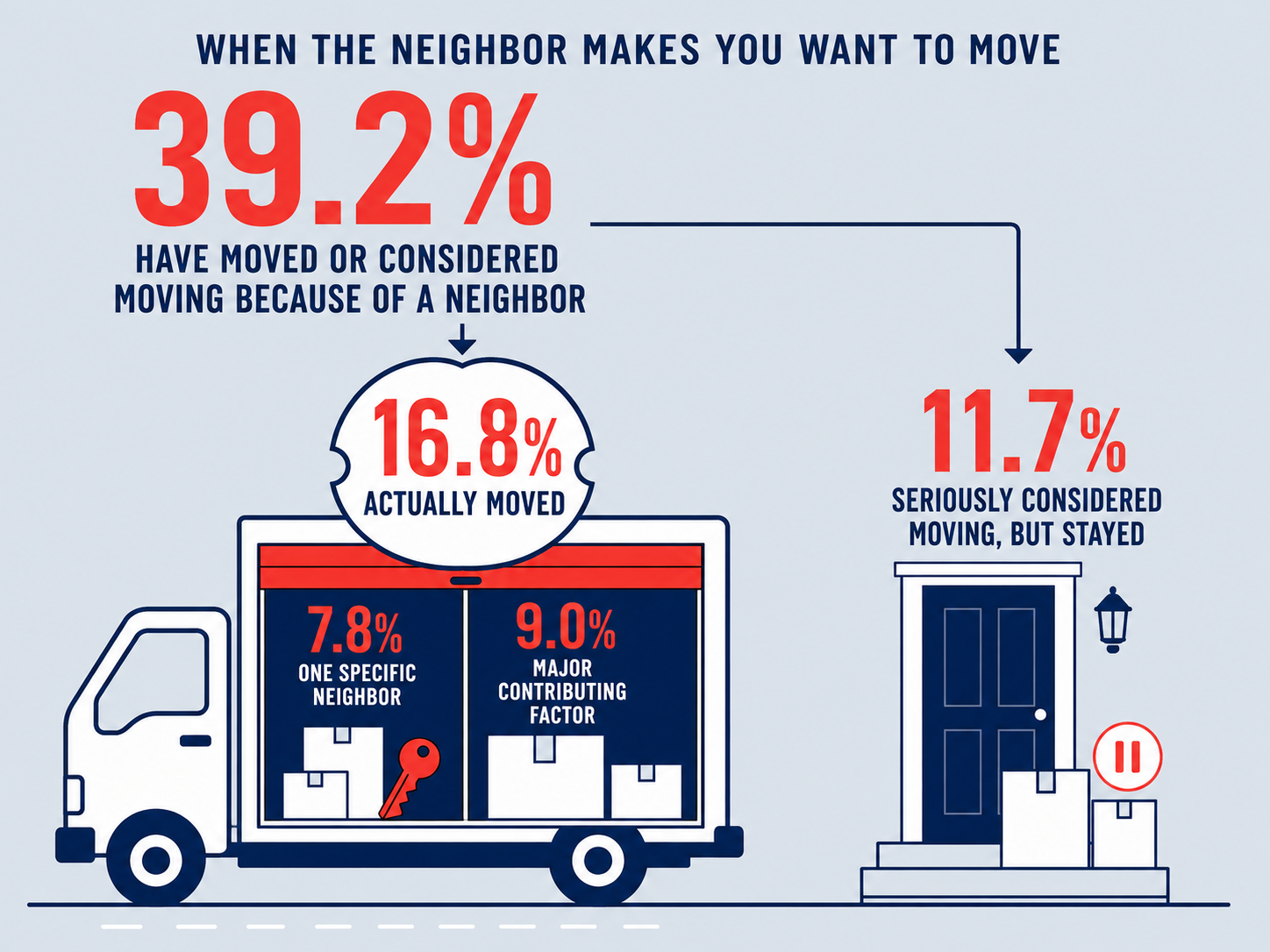 For some, the calculation goes past premiums. 16.8% of U.S. adults have moved because of a difficult neighbor. 7.8% say the move was entirely attributable to one specific person, and 9.0% say neighbor issues were a major contributing factor. For one in six Americans, the deciding factor in a move was who lived next door.
Add in those who thought about it and the number more than doubles. 39.2% have moved or considered moving, including 11.7% who seriously considered it and stayed anyway.
Coverage of the housing market over the past two years has focused on affordability locking people in place. This finding points to a driver that operates independently of price.
Millennials (23.3%) and Gen Z (roughly 26%) are about twice as likely to have actually moved as Gen X (11.0%), and the gap by race is among the widest in the study: 31.5% of Black respondents have moved over a neighbor, versus 14.2% of White respondents.
Half of Americans have turned to fences
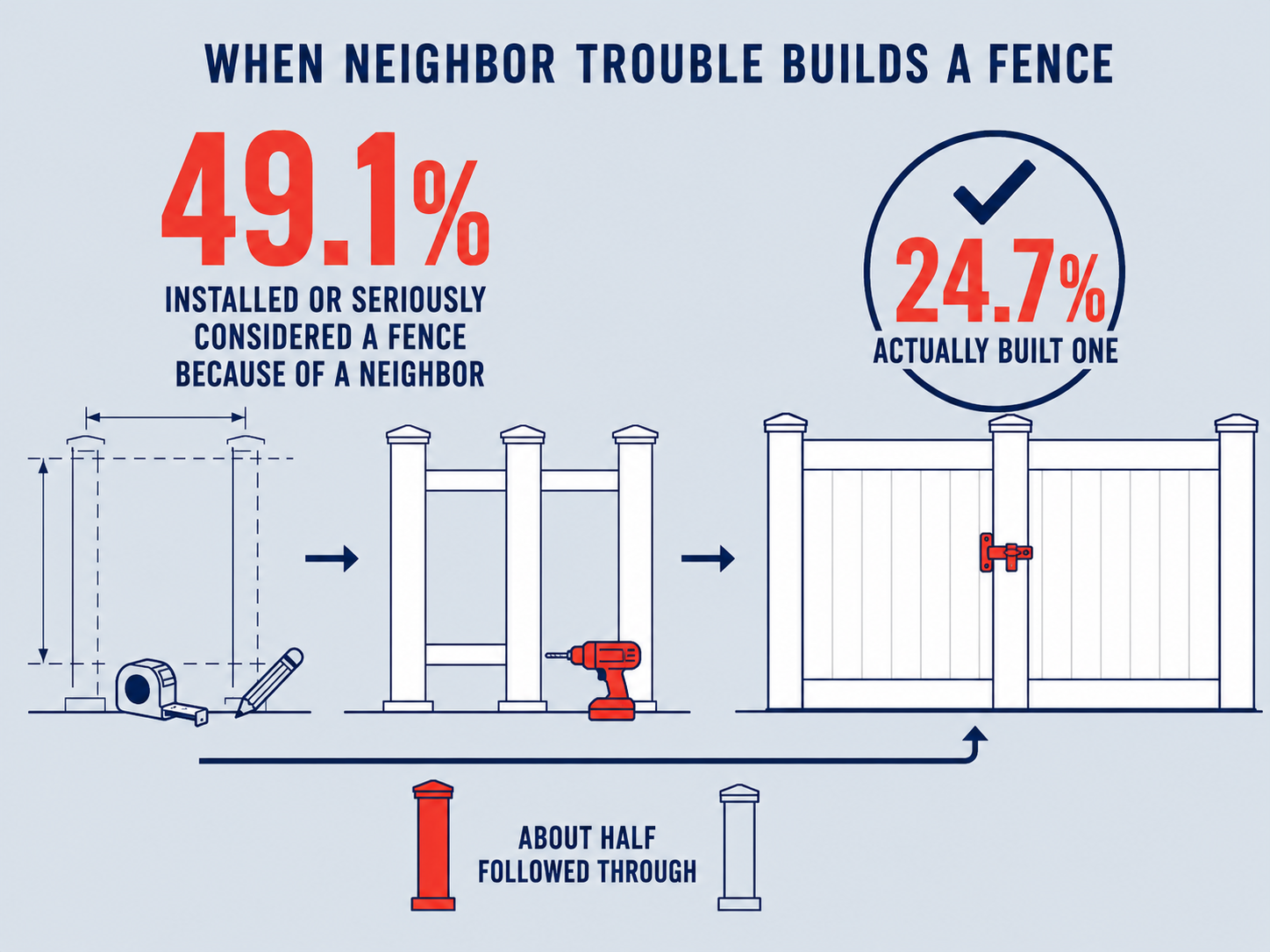 If moving is the last resort, the survey identifies the intermediate step half the country has reached for. 49.1% of Americans have installed or seriously considered installing a fence specifically because of neighbor behavior, and 24.7% actually built one.
Those who did report that it worked. Of the 247 respondents who installed a fence over a neighbor issue, 43.7% say it solved the problem immediately, and the rest say it helped even if it did not fix everything.
The appetite is strongest among the groups reporting the most friction. Gen Z is nearly twice as likely as Boomers to have installed or considered a fence, roughly 64% versus 36%.
Black (66.9%) and Hispanic (60.4%) respondents are far more likely than White respondents (45.8%) to have taken or considered the step. Among Black respondents, 26.6% say they installed a fence, and it solved the problem immediately, more than triple the 7.9% figure among White respondents.
Summary
The decline-of-community story assumed Americans stopped caring about their neighbors. The data suggests the opposite problem: they care enough to hide, to pay, to build and sometimes to leave.
Nearly half the country is managing a live tension, four in five weigh neighbors in the biggest purchase of their lives, and half have looked at their property line and considered making it more literal.
There is something quietly hopeful in the fence numbers, though. Most of the conflicts in this survey are not ideological or personal. They are spatial, about noise, sightlines, and where one yard ends and another begins.
Those are solvable problems, and the respondents who addressed the boundary directly report that the tension largely went away. The American neighborhood is not falling apart. It is renegotiating its terms, one property line at a time.
Methodology
To understand how Americans approach their relationships with neighbors, we surveyed 1,000 adults across the country in July 2026 via Pollfish. The survey was commissioned by Garon Fence. Participants answered questions about neighbor relationships, avoidance behaviors, boundary disputes, privacy preferences, home-buying decisions, and neighborhood conflict. Responses were analyzed by demographic groups to identify trends and disparities. Four questions allowed respondents to select more than one answer; percentages on those items reflect the share of respondents selecting each option and may sum to more than 100%. Demographic comparisons are drawn only between subgroups of 30 or more respondents.
Fair Use Policy
Users are welcome to utilize the insights and findings from this study for noncommercial purposes, such as academic research, educational presentations, and personal reference. When referencing or citing this article, please ensure proper attribution to maintain the integrity of the research. Direct linking to this article is permissible, and access to the original source of information is encouraged.
For commercial use or publication purposes, including but not limited to media outlets, websites, and promotional materials, please contact the authors for permission and licensing details. We appreciate your respect for intellectual property rights and adherence to ethical citation practices. Thank you for your interest in our research.

President of Garon Fence, Matt Prato, has transformed the family-owned business into a self-sustaining, independent, and thriving company. He brings expert knowledge in all things involving fencing, gates, and access solutions, shaped by years of hands-on installation and custom fabrication. He is a home improvement and outdoor design expert with decades of experience working on residential projects, and he advises homeowners on practical upgrades for gates, fences, railings, and outdoor installations.